Patches #73 answer board
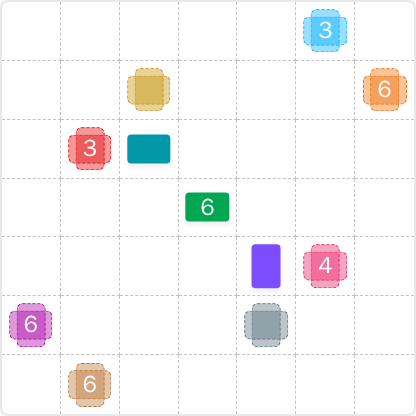

Friday, May 29, 2026 — the day this LinkedIn patch went live as that day's daily board.
Stuck on Patches #73? Below is the full colored board, the deductions that get you there, and the lessons you can carry to tomorrow's grid.
Friday, May 29, 2026
The answer is hidden until you ask for it. Work through the board, then hit Reveal the solution to compare your work — or pick another day.
One puzzle a day from LinkedIn isn't enough to call yourself good at this. Patches Unlimited hides the answer on every past board so you can replay them blind — and find out how much of your read on the grid actually held up.
Each step closes one rectangle. The order matters: every placement narrows what the next clue can be.
The most definitive starting point was the Brown 6. Its clue was in the last row (row 8). For a rectangle to contain this clue, it must lie on that row. A 2x3 shape would require rows 7 and 8, but other clues (like Gray and Purple) were already occupying the space above. This forced the Brown 6 to be a 1x6 rectangle, defining the entire bottom boundary of the puzzle.
With the Brown 1x6 in place, attention turned to the Purple 6 in the bottom-left. It was now boxed in from below by the Brown patch and from the right by the clues for the Red and Green patches. With no room to expand downwards or far to the right, its only possible configuration was a 6x1 vertical strip, forming a solid "wall" on the left side of the grid.
A similar logic applied to the top-right corner. The Blue 3 clue, tucked into the absolute corner, could only be a 1x3 or a 3x1 strip. Placing it as a 1x3 vertical strip created a clean, predictable boundary. This move was important because it contained the adjacent Orange 6, forcing it into a neat 3x2 rectangle. Trying it the other way (a 3x1 Blue strip) would have created an unsolvable, L-shaped gap.
Once these four foundational "wall" pieces (Brown, Purple, Blue, and Orange) were set, the rest of the grid was a straightforward chain reaction. The Green 6 was now bordered on three sides, locking it into a 3x2 shape. The Pink 4 was similarly hemmed in, forcing it into a 4x1 strip. The remaining pieces then slotted into the only spaces they could fit, completing the grid.
Always scan the edges and corners first. Clues on the perimeter have far fewer possible placements than those in the center. Solving them establishes the "frame" of the puzzle, making all subsequent decisions easier.
The Red 3 was a key secondary piece. Because 3 is a prime number, its patch could only be a 1x3 or 3x1 rectangle. This limited set of options makes prime-numbered clues anchors once the main perimeter is set.
The Blue 3 and Orange 6 were a pair. The solution for one directly dictated the solution for the other. When you see two clues packed tightly together, especially in a corner, analyze them as a single system. Consistent practice helps you spot these critical relationships faster.
Patches #73 ran on Friday, May 29, 2026 as part of LinkedIn's daily mini-game lineup. The board is no longer playable on LinkedIn itself, but the original colored grid lives at the source linked below.
Patches #73 is a 8×8 board — 64 cells in total — to be carved into several non-overlapping rectangles.
Yes — we replay the puzzle on LinkedIn Games every morning, capture the start and solved boards, and only publish once the colored solution matches LinkedIn's official reveal. If the LinkedIn server changes the daily puzzle mid-day, we reflect the change here within minutes.