Patches #74 answer board
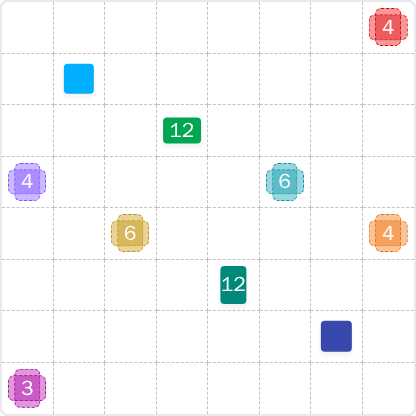

Saturday, May 30, 2026 — the day this LinkedIn patch went live as that day's daily board.
Stuck on Patches #74? Below is the full colored board, the deductions that get you there, and the lessons you can carry to tomorrow's grid.
Saturday, May 30, 2026
The answer is hidden until you ask for it. Work through the board, then hit Reveal the solution to compare your work — or pick another day.
One puzzle a day from LinkedIn isn't enough to call yourself good at this. Patches Unlimited hides the answer on every past board so you can replay them blind — and find out how much of your read on the grid actually held up.
Each step closes one rectangle. The order matters: every placement narrows what the next clue can be.
The most starting move had nothing to do with a single shape. First, we identify the grid size: 8x8, for a total area of 64 cells. Next, we sum the known numbered clues: 4+12+4+6+6+4+12+3 = 51. The total area for the two unnumbered squares (Light Blue and Dark Blue) must be the difference: 64 - 51 = 13 cells. The only two perfect squares that sum to 13 are 4 (a 2x2 square) and 9 (a 3x3 square). With this single calculation, we've defined the exact size of our two most ambiguous pieces before placing a single one. This is a important practice for complex grids.
A subtle but critical clue was the Orange 4. Since 4 is a perfect square, this piece was constrained to be a 2x2 square, not a 1x4 strip. We now had three squares to place: a 3x3, a 2x2, and another 2x2.
The Pink 3 in the bottom-left corner was the perfect physical starting point. As a prime number, its dimensions can only be 1x3 or 3x1. Placed in a corner, it cannot be a 1x3 vertical strip (as that would leave an unfillable 2-cell gap beneath it). Therefore, it must be a 3x1 strip along the bottom edge.
Placing the Pink 3x1 immediately forces the Purple 4 above it. Confined to the left edge and boxed in by the Pink 3, its only possible fit is a 1x4 vertical strip.
This leaves a 3-cell wide space in the top-left. Our 3x3 square (the Light Blue one) is the only piece that fits this space. Placing it defines the entire top-left quadrant.
The placement of the Light Blue 3x3 and the Red 4 (which must be a 4x1 strip in its corner) creates a 4x3 empty space between them, which is a containment for the Green 12.
Always start your practice by calculating the total grid area and subtracting the sum of numbered clues. This instantly reveals the total size of any unnumbered shapes (like squares or L-shapes), often defining them completely.
Clues with prime numbers (like 3) are restrictive. They can only be 1xN strips. When you find one on an edge or in a corner, it often has only one possible orientation, giving you a solid foundation to build upon.
Don't look for the square symbols. Any numbered piece that is a perfect square (4, 9, 16...) is also highly constrained. The Orange 4 had to be a 2x2 square, which was as important as knowing the unnumbered squares' sizes.
Patches #74 ran on Saturday, May 30, 2026 as part of LinkedIn's daily mini-game lineup. The board is no longer playable on LinkedIn itself, but the original colored grid lives at the source linked below.
Patches #74 is a 8×8 board — 64 cells in total — to be carved into several non-overlapping rectangles.
Yes — we replay the puzzle on LinkedIn Games every morning, capture the start and solved boards, and only publish once the colored solution matches LinkedIn's official reveal. If the LinkedIn server changes the daily puzzle mid-day, we reflect the change here within minutes.